…the infinite tango takes me towards everything…Jorge Luis Borges
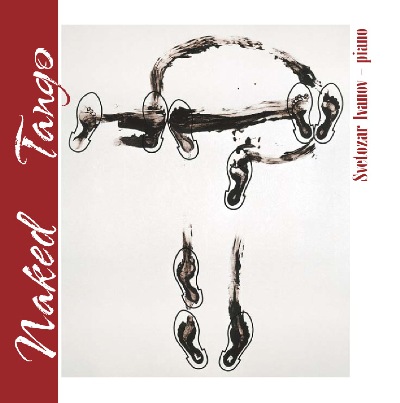
In 1914 Erik Satie composed “Perpetual Tango” which was meant to be repeated eternally. Seventy years later John Cage wrote a piece with the same title, shape and structure as Satie’s tango. Separately and superimposed, these two works encircle this CD endlessly. The title, “Naked Tango” is borrowed from a stunning work (reproduced on the cover) by Argentine artist Guillermo Kuitca. I was very fortunate to know Robert Helps during the last few years of his life and he remains a great inspiration for me as a person and as a musician. His music, which is the heart of this CD, along with timeless sounds from the distant past (Tisdall, Rameau) is woven into the perpetual rhythm of the tango as expressed by Nazareth, Stravinsky, Shchedrin and Barber. Svetozar Ivanov
Fanfare Magazine, March/April 2010 There
are recital and disc programs that are so thought-provoking as to reveal a
window into the musical philosophy of the performer. And then there are
delightful rarities like pianist Svetozar Ivanov’s Naked Tango that push
the concept even further, coaxing the listener to consider links between pieces
and eras in ways rarely examined. The genre of the tango might not seem to be a
likely avenue for this kind of scrutiny, but Ivanov’s choices prove wonderfully
fruitful.
The
connections between works don’t beat you over the head with obvious common
threads, nor do they seem like shotgun marriages. “Progression” would be the
wrong adjective to describe the long timeline heard here. “Old” does not equate
to “primitive,” nor does “modern” imply superiority or innate sophistication.
The pianist doesn’t limit himself to the formal European concert hall in this
gently arresting group of intimate, often understated and sly works.
If
you are imagining from the title that this music might conjure the heat of
South America and propel you to the dance floor, think again. Physical movement
is implied in many of the pieces, but quiet contemplation is the more likely
response. This is also not a brazen attempt to jump onto the overcrowded
Piazzolla bandwagon—not a single work from the Argentine appears on the disc.
Renaissance
English composer William Tisdale worked centuries before the advent of tango
music, but his Galiarda and Pavana Chromatica are airy, light-footed dances
that Ivanov brings to life with a sensitive and sure touch. Apparently there
are only seven known surviving movements of this composer, most from the
Fitzwilliam Virginal Book. Judging by the quality of these gems, we can only
hope an enterprising sleuth uncovers more. Robert Helps’s Recollections
seem a bit off message, but they’re strong, pithy works nonetheless.
Shchedrin’s À la Albeniz is a lush and sultry miniature.
The
heaviest work on the disc is Stravinsky’s Tango, which isn’t
particularly substantial and seems almost leaden in comparison to the other
offerings. Samuel Barber’s Hesitation Tango pushes the genre in a
similar direction, with thick, bracing chords that serve as a counterforce to
the sharp syncopations. The finishing bars switch gears considerably, and
Ivanov’s chops are suddenly put to the test, one that he passes with
breathtaking ease. At the other end of the spectrum is Ernesto Nazareth’s
lilting Tango Ninth of July and a bubbly version of Rameau’s La Poule
in which the fowl pecks away at its food with amusing irregularity.
Dharshini
Tambiah joins Ivanov in Helps’s evocative Eventually the Carousel Begins
for two pianos. Both tonality and meter are more grounded here than in the
composer’s other works, a testament to Helps’s skillful versatility. The disc
aptly concludes with John Cage’s Perpetual Tango and a quasi-reprise of
the Satie, the work that informed Cage’s dance movement. This isn’t the first
time the Satie and/or Cage have begun and finished a program, but it is an
effective strategy nonetheless, reaffirming the cyclical and gossamer nature of
most of the material.
Some discs are so burdened with long-winded
notes it can take nearly as long to read them as listen to the music. While
this recording could easily provoke endless commentary, Ivanov goes for the
minimalist route, giving the listener a mere two short paragraphs. He lets the
music speak for itself, and his clear and thoughtful performances enhance the
process. If you occasionally grow weary of the barnstorming ferocity of many
piano recordings, you will no doubt enjoy this finely conceived and immensely
listenable disc. Michael Cameron
I have always been fascinated by the artistic spirit of early 20th century Europe. Time of changes, time of experiments – the beginning of modern times! In the next few pages I have included a painting and a poem to accompany each of the compositions on this CD. My intention is not to complement or represent the music through these works; rather my hope is that they help portray the artistic climate of the time and place in which the composers wrote these pieces. Debussy’s impressionistic “Images II” was composed in 1907 – same year as Monet’s “Water-Lilies, Nymphéas” and at a time when the young Apollinaire was becoming one of the most popular members of the artistic community of Paris. Klimt and Altenberg were part of Vienna's cultural elite and were especially influential on young Berg at the time he wrote his sonata op.1 – 1908. The expressionism of Schoenberg’s op.11 from 1909 corresponds to the emotional intensity of two other Vienna artists from that time - Schiele and George (one of Schoenberg’s favorite poets). And finally, Ciurlionis’ idea about synthesis of music and color reminds us of Scriabin’s grandiose, but unfinished project for synthesis of all arts – Mysterium. Included here is the first verse of Scriabin’s text to the Prefatory Action which was intended as the prelude to the Mysterium.
Svetozar Ivanov
Fanfare Magazine, March/April 2010 Svetozar
Ivanov’s notes in the similarly tightly and intelligently themed Naked Tango
are scant, but they’re a bit more expansive in this one, perhaps a result of
the more serious musical points at hand. He is still clearly reluctant to make
connections that are overly verbose, but he does provide a few short paragraphs
that point to links within a brief era of musical history. He also includes a
painting and a poem associated with each of the four composers, inviting the
listener to consider changes in the arts that were percolating at the beginning
of the 20th century, arguably a time of greater ferment than any other.
A
mere eight years separate these piano works, but 33 years separate the dates of
birth of the composers. This generational divide, along with distinct regional
styles, accounts for the differences among the works. Yet a truly profound
contrast can be heard only between the Debussy and the others. Is this a result
of the generation gap, or is there a more profound schism between France and
the other two regions than between Austria and Russia? This is just one of the
many questions the program raises, along with the observation that as notable
as these distinctions are, they seem almost trivial compared to the divergences
in compositional methods a half or full century later.
Debussy’s
links to the other arts are well documented, and the inclusion of the Monet
painting and poem of Apollinaire in the notes are relevant reminders. Ivanov’s
textures are not as hazy as some pianists in this literature, but neither does
he apply a heavy hand in a misguided attempt to insinuate sonic links with the
other works.
What
strikes me about Berg’s astonishing op. 1 in this context is the degree to which
certain gestures hint at the tonal ambiguity not only of Schoenberg, but also
of Scriabin (the opening bars are a case in point). While Berg’s sonata sounds
just as “advanced” as most of the other works, it also comes in a grander, more
romantically shaped package, a distinction Ivanov is keen to underline.
Schoenberg’s
connections to the visual arts are more concrete, as he was a gifted painter
and insightful interpreter of the poet Stefan George. And yet his three pieces
seem more abstract, more purely musical than the others.
Scriabin’s
interest in the relationship of arts is even more insistent than the others, a
proclivity that leads to some futuristic and even bizarre hypotheses. One might
expect a circular influence to be audible, since Debussy (and French culture in
general) had long exerted a particular pull in Russian arts. These late works
of Scriabin don’t seem to evoke the French master, with the notable exception
of the second prelude from op. 74 (Très lent, contemplatif). Instead we
hear that antsy, unsettled, and obsessive ambiguity that is the peculiar (and
sometimes disturbing) legacy of the misunderstood Russian. That said, Ivanov
finds a French vein in this music, serving it up with a transparent touch
similar to that used in Images.
It
would be pointless to attempt a piece-by-piece comparison of his readings with
the dozens available for each work. If ever a performer seems to be urging his
listeners to digest a disc in its entirety, this would be the one. The
performances are all finely executed, but the key is the juxtapositions. There
was something profound and disturbing in the air from 1907 to 1914, Ivanov
seems to be saying, and his disc gives the listener a tantalizing whiff. Michael
Cameron
In
the disc Vers la flame, Svetozar Ivanov is very persuasive in the three
Debussy pieces. Consider Cloches à travers les feuilles, which gradually
evolves from gentle pianissimo to incisive crystalline figuration,
blossoming at last into an intoxicating blend of color, dynamics, shading, and
line. Ivanov shapes the piece lovingly, paying equal attention to the chiming
of the bells and the fluttering leaves without disrupting the overall flow. His
piano’s velvety but clear tone is enhanced by the pleasantly reverberant
acoustic, and the pedal is applied with an artist’s brush. Ivanov captures
Debussy whole, not limiting himself to delicate refinement: Listen to Poissons
d’or as it explodes in a rapturous burst that quite sweeps the listener
away. At once supple, radiant, and evocative, these are exemplary realizations
of Debussy’s unique compositions. The Berg Sonata emerges as lush, passionate,
as convincing in the reflective moments as in the periodic torrential
outbursts. Ivanov’s dramatically communicative reading embraces the
late-Romanticism at the heart of Berg’s fluid harmonic and melodic lyricism.
The Drei Klavierstücke are what one might term accessible Schoenberg. At times
close to Berg and alternating between fleet flourishes and somber ostinatos,
this is Schoenberg before he became a 12-tone composer. Ivanov deftly switches
gears among the incipient violence, latent morbidity, and brief but dazzling
scintillance. The Scriabin preludes were the last things he composed and the
gestures and harmonies that we hear as mystical or ecstatic are all there, albeit
in condensed form: The longest takes just 1:57. In the more volatile of the
preludes and in Vers la flamme, Ivanov plays with the extroverted flair
of a natural Scriabinist, alive to the composer’s striving for transcendence.
Ivanov’s thoroughly musical and often thrilling interpretations enliven a
thoughtfully conceived recital that vividly animates several of the dominant
aesthetic currents of the early 20th century.
Who
can resist a tango? Certainly not Svetozar Ivanov, whose Naked Tango CD
brings us the lilting gaiety, tinged with melancholy, of the Nazareth; the
sardonic, biting wit of the Stravinsky with its surprisingly lyrical interlude;
the whimsical but beautiful Satie, plucked from the ether where it’s playing
endlessly, if inaudibly; the Barber, whose central song could easily have been
a hit in Argentina during the heyday of the tango; the mysterious, otherworldly
aura of Radiance, by Helps, which hints at tango; Shchedrin’s dark-hued
tribute to Spanish rhythm and romance; and to round things off, Cage’s
delicately plucked miniature, cleverly combined by Ivanov with the Satie. Music
by Tisdale and Rameau, while not tangos, brings a taste of the past, reminding
us that dance was often the impetus to composition; could the pavane (the dance
form), with its sentimental gravity, be heard as a precursor to the tango?
Ivanov’s lightly pedaled performance shows the impress of his alternate career
as harpsichordist: clarity, crisp ornament, joyous execution of the Galiarda’s
divisions, and rhythmic freedom. After a vigorous opening, Helps’s Eventually
the Carousel Begins alternates Radiance’s “starry” style with other
episodes pensive, swirling, and delicately allusive. While it is not a tango per
se, one can often sense that insinuating rhythm beneath the softly glowing
surface.
Two
brief quotes taken from the booklet best explain Ivanov’s inspiration in
assembling this tantalizing program:
Jorge
Luis Borges: “The infinite tango takes me towards everything.”
And
Ivanov, himself: “In 1914 Erik Satie composed Perpetual Tango, which was
meant to be repeated eternally. Seventy years later John Cage wrote a piece
with the same title, shape, and structure as Satie’s tango. Separately and
superimposed, these two works encircle this CD endlessly.”
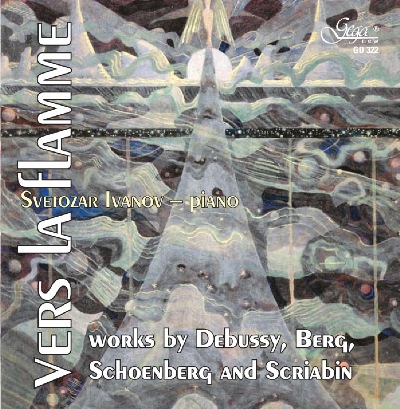
Vers la flamme’s booklet contains paintings of the period, with each paired with an
appropriate poem. The Naked Tango’s cover reproduces the similarly
titled painting. Both CDs are very well recorded; the piano always sounds
natural and pleasing to the ear. Robert Schulslaper
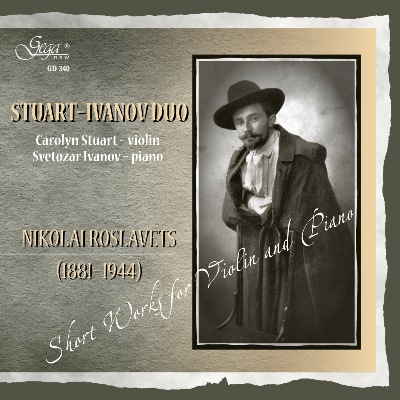
NIKOLAI ROSLAVETS Short Works for Violin and Piano Gega New, Catalog #340 Stuart-Ivanov Duo (Carolyn Stuart – violin, Svetozar Ivanov – piano)
This collection seeks to offer a portrait of this composer who was almost erased from Russian musical history, as seen through a chronological offering of some of his distinctive short pieces for violin and piano. Alongside some of Roslavets’s signature published works, thid disc includes several unpublished miniatures, presented here in their world premiere recordings.
"In every regard a showcase for Stuart's and Ivanov's musical and stylistic mastery." Robert Maxham, Fanfare Magazine

"Carolyn Stuart and Svetozar Ivanov provide all of the expertise one can ask for in their performances of these works." Steven E. Ritter, Fanfare Magazine